
McLean, VA · Garage Door Service
Garage Door Spring Repair for Pimmit Hills Homes
Pimmit Hills homes built mid-1960s run original torsion springs on cold-rated steel. McLean Garage Door Pros covers this 2-mile stretch for broken springs.
- Repairs & new doors
- Springs & openers
- Serving 5 nearby communities
Why This Fails Locally
Pimmit Hills is small - about 2,196 households, a fraction of the 267,392 households spread across the wider service area we cover out of McLean. That size matters for spring work: it means the door stock here is tighter in age and type than you'd see across a bigger patch of suburbs, so the failures repeat in the same handful of ways instead of spanning every era of hardware ever installed.
Most houses in Pimmit Hills went up around 1966, a good decade ahead of the 1977 median build year for the broader area we serve. That decade matters. A door installed in the mid-60s was almost certainly set up with a different spring configuration than one installed in the late 70s or 80s - often a single extension spring system rather than the torsion setup that became standard later. When a spring on one of these older doors lets go, the fix isn't a generic swap; it's matching hardware to a system that predates most of what's on shelves today.
Median household income here runs $168,548, well above the $143,796 median across the rest of the service area. That doesn't change how a spring breaks, but it does shape what people here tend to ask for - full hardware upgrades over patch jobs, more often than not.
Doing It Yourself
A torsion spring under full tension holds enough stored force to break a wrist or worse if the winding bars slip. An extension spring, the kind more common on Pimmit Hills' 1960s-era doors, is less violent to work on but still dangerous if the safety cable is missing or frayed - and on hardware this old, it often is.
If you're set on doing it yourself, at minimum check whether your door uses torsion or extension springs before you buy anything. They are not interchangeable, and an extension spring rated for the wrong door weight will stretch, sag, or snap early.
Here's the honest limitation: we don't talk anyone through a torsion spring replacement over the phone, and we won't walk you through winding bars in a blog post either. The risk-to-savings ratio is bad. Extension spring swaps on a single door are more forgiving, but if the door is original to a 1966 build, the drums, cable, and track may all be past their service life too, and replacing just the spring can mean doing the job again in a year.
Where This Job Goes Sideways
The most common mistake on a house this age is buying a spring by door size alone and ignoring the door's actual weight, which creeps up over decades as panels get repainted, insulated, or swapped piece by piece. A spring sized for the original 1966 door won't necessarily lift the door as it exists today.
The second mistake is mixing a new torsion conversion onto an old extension-spring frame without replacing the track hardware to match. It can look fine for a few weeks and then bind, because the stress on the header and jambs is different between the two systems.
Cold matters here too. This area sits in a COLD-rated climate band, and steel spring coil that's been cycling through winter contraction and summer expansion since the Johnson administration doesn't fail cleanly - it fatigues unevenly, so one coil near the end gives out first while the rest of the spring still looks fine. That uneven wear is why a spring can seem to hold, then snap without warning on a cold morning.
How It Shows Up
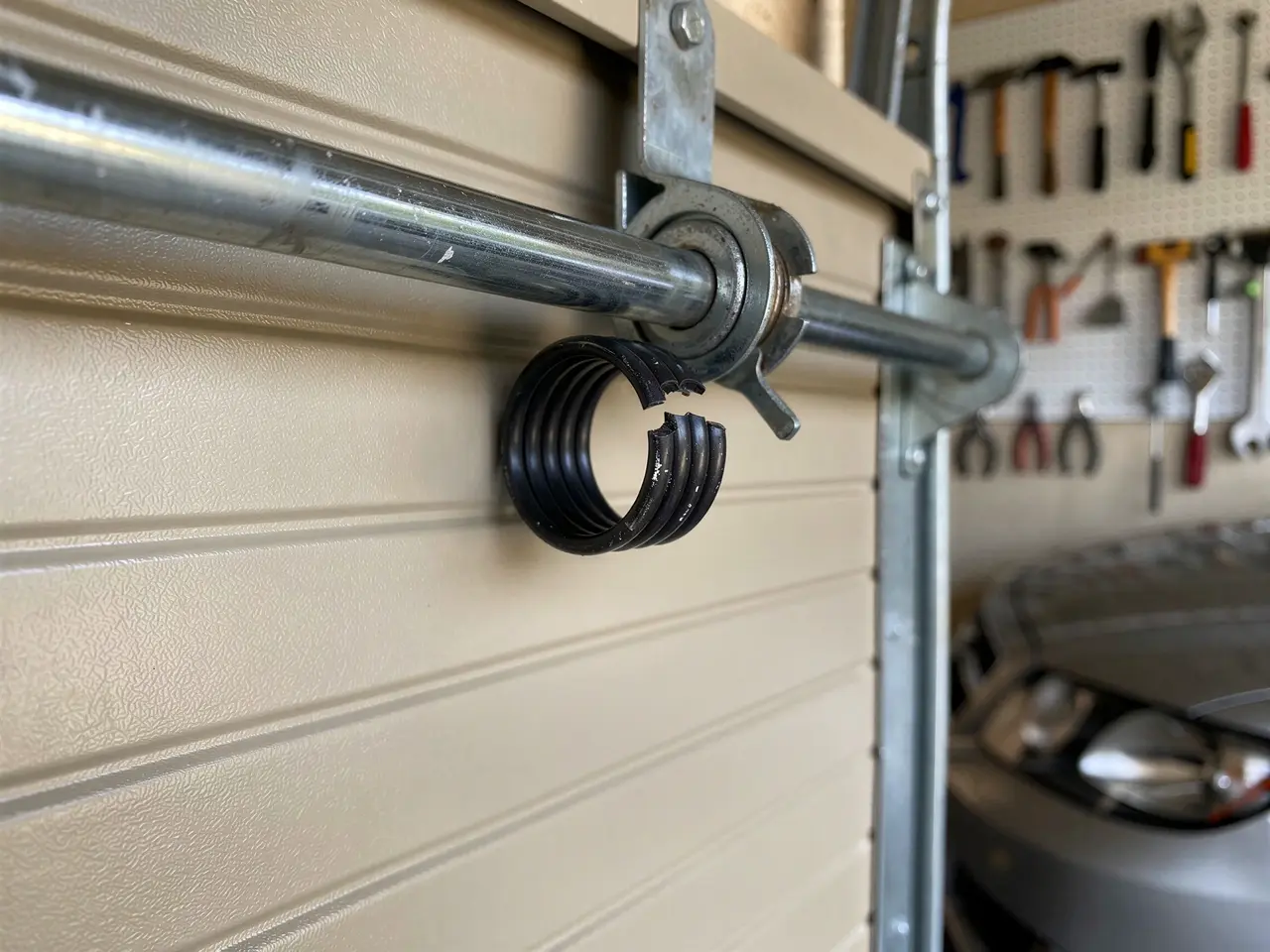
The door won't lift past a few inches, or the opener strains and reverses without the door moving - that's usually a spring that's lost tension gradually rather than snapping outright. A loud bang from the garage, often mistaken for something falling, is almost always a torsion spring letting go all at once.
On older extension-spring doors, you'll sometimes see one side of the door hang lower than the other before the spring fully fails - a slow give rather than a sudden break. If the door feels heavy when you lift it by hand with the opener disconnected, that's a spring already carrying less than its full load.
Cables that look slack or frayed near the bottom bracket are often a sign the spring side has already shifted tension unevenly, which happens more on original 1960s hardware than on anything installed in the last twenty years.
Booking a Visit
We run out of McLean, two miles from Pimmit Hills - the shortest trip of any suburb we cover in this part of the service area. That doesn't mean a branch office here or a guaranteed response window; it means the drive is short and we know the hardware era going in.
When you call, tell us whether the door has one spring or two, and whether you can see it's a coil running horizontal above the door (torsion) or stretched alongside the upper track (extension). That alone tells us which truck stock to load before we leave McLean.
For general repair work on doors in this suburb beyond spring failure, see our Pimmit Hills garage door repair page. For the broader spring repair service across the McLean area, including how pricing and scheduling work, see garage door spring repair in McLean, VA.
Parts We Carry
We stock torsion springs sized for the common door weights that show up on 1960s-era single and double garage doors, along with standard extension springs and the safety cables that should run through them. Cable, drums, and bottom brackets that match older track widths are also on the truck, since those tend to fail around the same time as the spring itself on a door this age.
What we don't carry are obsolete factory parts for doors that were custom-milled decades ago - wood panel doors with non-standard hardware sometimes need a special-order part, and that can mean a wait. If your door falls into that category, we'll tell you upfront rather than patch something that won't hold, and talk through whether a full replacement makes more sense than chasing parts for a door nearing the end of its run.
Frequently asked questions
Why did my garage door spring break on such a cold morning?
Steel spring coil contracts in cold weather, and in a climate band rated COLD severe, that contraction adds stress to a coil that's already fatigued from decades of cycling. On a door built around 1966, that fatigue has had close to sixty years to accumulate, so a cold snap is often just the final push on a spring that was already near the end.
Does my 1960s house need a torsion spring or an extension spring?
Look above the door: a torsion spring sits on a shaft centered just above the opening. Extension springs run along the upper tracks on either side and stretch as the door closes. Many Pimmit Hills homes built in the mid-1960s started with extension springs, though some have been converted to torsion since. Tell us which you have when you call.
Is it worth replacing just the spring on an older door?
Often yes, if the track, drums, and cable are still sound. But on a door original to a 1966 build, those parts are frequently near failure too. We'll check the whole system on the visit rather than replace the spring alone and send you into another repair call within the year.
More garage door services in Pimmit Hills
Book garage door service in McLean
Call now or request a quote - tell us what the door is doing and where you are.