
McLean, VA · Garage Door Service
Off-Track Garage Door Repair for Pimmit Hills' 1960s Track Hardware
Pimmit Hills homes date to around 1966, a lot of them still running extension-spring track. Here's why that hardware comes off the rail and how we fix it.
- Repairs & new doors
- Springs & openers
- Serving 5 nearby communities
Why This Fails Locally
Most houses in Pimmit Hills went up around 1966, back when extension springs and light galvanized steel track were the standard off-the-shelf setup on a single garage door. That hardware wasn't built to run forever, and a lot of it is still up there, original or close to it. The track from that era is thinner gauge than what goes in today, the brackets are fewer and lighter, and the jamb screws holding it to the framing have had close to sixty years to work loose.
A door on a 1966-built house out here almost never had torsion hardware from the factory - if it's torsion now, someone added it later. That matters because torsion and extension-spring setups pull on the track in different directions, and a lot of off-track calls in this area trace back to a mismatched upgrade: new rollers or a new opener bolted onto track that was never meant to carry the load it's carrying now. The fix isn't always 'put it back on the rail.' Sometimes the rail itself is the problem, and it's thirty-plus years past its working life.
Doing It Yourself
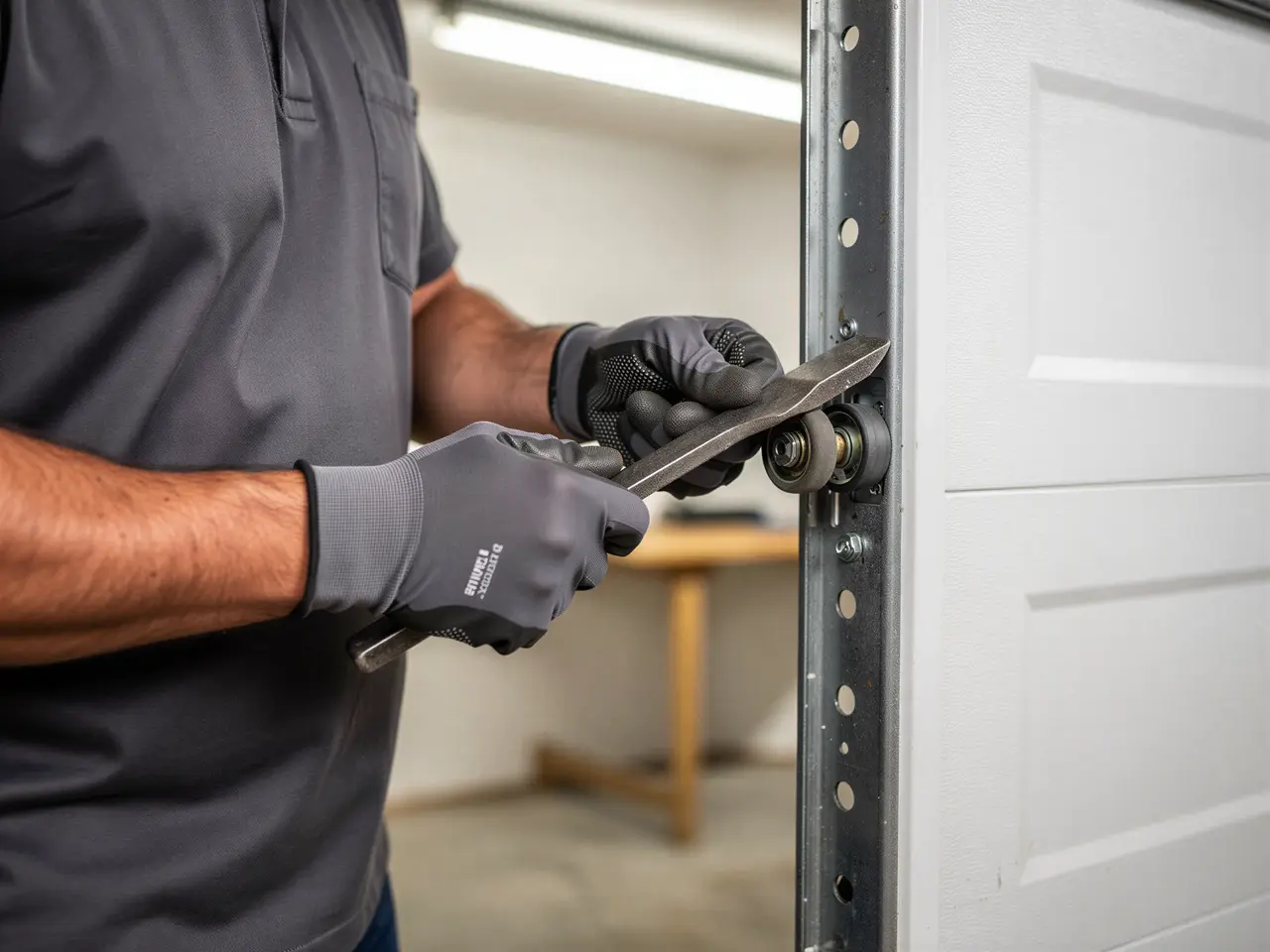
If one side of the door has popped off the track and the other hasn't, do not run the opener. That's the fastest way to bend the horizontal rail or rip a bracket off the jamb, and once that happens you're looking at track replacement instead of a reset. Disconnect the opener, see if the door moves freely by hand, and check whether the rollers are sitting in the track channel or hanging outside it.
We'll be straight with you: a door that's come off the track on one side can sometimes be walked back on by hand if you catch it early and the track itself isn't bent. But on 1966-era hardware, the rail is often the weak point, not the roller, and forcing it back into shape usually just moves the failure point six inches down the rail. If you're not sure whether the track is bent or just the roller's out, that's a call for us, not a project for a Saturday.
Where This Job Goes Sideways
The job gets harder when the bracket pulls clean out of the jamb instead of just bending. On houses from this era, the wood framing around the door opening has had decades of seasonal movement, and the screws holding the track bracket don't always have solid wood left to bite into. We've opened up brackets here where the original screw holes were stripped out and just sitting loose in the cavity.
The other place it goes sideways is cable. If the door came off the track because a cable frayed or slipped its drum, putting the door back on the rail without addressing the cable just sets up the same failure again, usually within weeks. And because winters here run cold, metal track and brackets contract and expand enough over a season to loosen fasteners that were already marginal. We don't patch a stripped bracket with a longer screw and call it fixed - if the jamb wood is gone, we're reinforcing it before anything goes back on the rail.
How It Shows Up
The most common version: the door looks like it's hanging at an angle, lower on one side, and you can see daylight between the roller and the track channel on that side. Sometimes it's quieter than that - the door runs fine most of the way up but grinds or hangs for a second where the rail has a slight bend.
Another pattern on this hardware is a loud bang followed by the door refusing to move at all. That's often a roller finally giving up and dropping out of a track channel that's been slightly out of alignment for a while. And on double doors with a center support, we sometimes get a call where only the outer half has come off - the door still closes, just unevenly, dragging on one side. None of these are a 'wait and see' situation. A door running on a partially off track is putting uneven load on whatever's left holding it, and that part fails next.
Booking a Visit
We run this call out of McLean, about two miles from Pimmit Hills, so getting someone out to look at a track that's come loose doesn't mean sitting on a long wait. Tell us what you're seeing - which side came off, whether the door still moves, whether you heard a bang - and we'll bring the right rail stock and brackets for the job instead of guessing on-site.
For general repair work on your door beyond the track itself, the Pimmit Hills repair page covers what else we handle out here. And if you're actually in McLean proper, the off-track page for McLean is the one written for that housing stock instead of this one.
Parts We Carry
We carry track sections, roller brackets, and end bearing plates sized for the lighter-gauge rail common on 1960s-era doors, along with standard rollers and cable in the sizes that fit extension-spring setups from that period. If your bracket needs to be reset into solid framing rather than just rescrewed, we carry the hardware for that too.
What we don't stock on the truck is a torsion conversion kit custom-fit to every possible door width and headroom combination - if your off-track problem turns into 'let's convert this to torsion,' that's usually a scheduled job with parts ordered ahead, not a same-visit fix. We'd rather tell you that up front than have you wait on-site while we figure out what doesn't fit.
Frequently asked questions
Why does my door keep coming off the track in Pimmit Hills but my neighbor's never has?
It usually comes down to which hardware generation is actually on the door. Even on houses built the same year, some have had rollers or openers upgraded without the track being checked, which puts load on rail that was never sized for it. The neighbor's door may still be running the lighter original setup within its limits.
Can you just push the door back onto the track yourself?
Sometimes, if the rail isn't bent and you catch it before the opener forces it further. But on hardware from the 1960s the rail is often the actual problem, not the roller, and pushing it back into place without checking the track just delays the next failure.
Is it worth fixing old track or should I replace the whole thing?
If the rail is bent or the brackets have pulled out of the jamb more than once, replacement is usually the better call financially. A straightened rail rarely holds alignment as well as new track, and you end up paying for the same visit twice.
More garage door services in Pimmit Hills
Book garage door service in McLean
Call now or request a quote - tell us what the door is doing and where you are.